

- Your cart is empty
- Continue shopping


Menopause is a natural stage in a woman’s life. It is not a disease. However, hormonal changes can cause symptoms that affect sleep, mood, concentration, intimate comfort and quality of life.
Every woman experiences this transition differently. Some notice almost no changes. Others experience severe symptoms that interfere with work, personal relationships or daily activities.
Recognising the signs of menopause can help women seek appropriate support. It also makes it easier to distinguish common symptoms from situations that require medical assessment.
What is menopause?
Menopause is defined as the point at which a woman has gone 12 consecutive months without a menstrual period, provided there is no other cause for the absence of menstruation.
For most women, it occurs between the ages of 45 and 55. Reduced ovarian activity leads to a decrease in oestrogen production. These hormones are involved in regulating the menstrual cycle, body temperature, bone health and several other processes in the body.
Menopause is part of a process that includes several stages.
Perimenopause
Perimenopause is the transitional period that occurs before menopause.
It can begin several years before the final menstrual period. During this stage, menstrual cycles may become irregular. Hot flushes, sleep disturbances, mood changes and other symptoms may also occur.
Despite menstrual changes, ovulation may still occur. Pregnancy is therefore still possible during perimenopause.
Menopause
Menopause is confirmed after 12 full months without a menstrual period.
It does not refer to the entire period during which symptoms occur. It is a specific point within the hormonal transition.
Postmenopause
Postmenopause begins after menopause has been confirmed.
During postmenopause, some symptoms may decrease over time in most women. Others, such as vaginal dryness, urinary changes or loss of bone mass, are likely to persist and may require ongoing monitoring.
What are the symptoms of menopause?
Menopause symptoms vary considerably. Not all women experience the same symptoms or the same level of severity.
The most common signs include:
changes in the frequency and flow of menstrual periods during the menopausal transition;
hot flushes;
night sweats;
difficulty falling asleep or staying asleep;
tiredness;
irritability or mood swings;
anxiety or low mood;
difficulty concentrating;
a feeling of “brain fog”;
muscle or joint pain;
palpitations;
vaginal dryness;
burning, irritation or intimate discomfort;
more frequent urinary symptoms;
reduced sexual desire;
changes in the skin and hair;
changes in body composition.
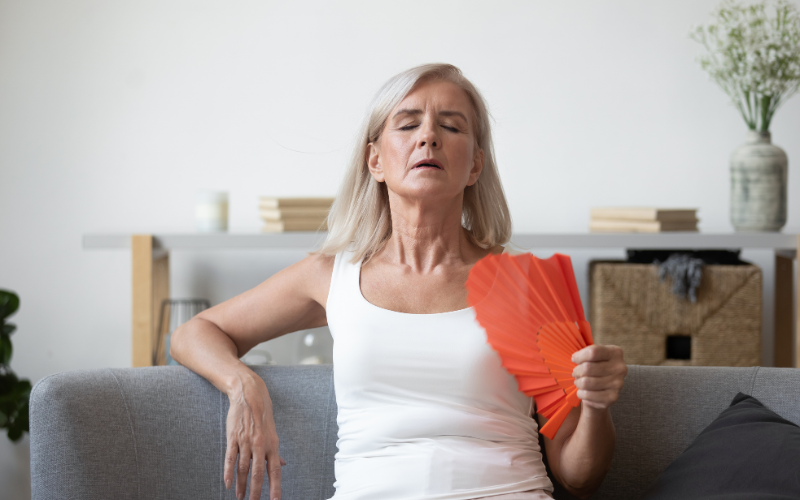
Hot flushes cause a sudden feeling of heat, particularly in the face, neck and chest. They may be accompanied by sweating, palpitations or discomfort. When they occur at night, they can disrupt sleep and increase tiredness the following day.
These symptoms may also have other causes. A recent change should not automatically be attributed to menopause, particularly when it is severe, persistent or unusual.
Are tests required to confirm menopause?
For many women over the age of 45, the assessment is based on age, symptoms and changes in the menstrual cycle.
In most cases, hormone tests are not required. Hormone levels can fluctuate considerably during perimenopause, which makes a single test result difficult to interpret.
A doctor may request tests when:
symptoms develop before the age of 45;
menopause before the age of 40 is suspected;
the woman is using hormonal contraception;
menstruation has stopped for another reason;
the symptoms are not typical;
thyroid problems, anaemia or other conditions need to be ruled out.
The absence of menstruation before the age of 40 should be assessed by a doctor. It may be associated with premature ovarian insufficiency and requires specific medical monitoring.
How can menopause symptoms be relieved in daily life?
Lifestyle measures do not eliminate every symptom. However, they can improve well-being and help protect long-term health.
Exercise regularly
Regular exercise helps preserve muscle mass, mobility and bone health. It may also help improve sleep, mood and cardiovascular health.
It can be useful to combine:
walking or other aerobic activities;
strength exercises;
balance and flexibility exercises;
weight-bearing activities appropriate to the person’s physical condition.
The intensity should be adapted to each person’s age, health status and level of experience.
Protect bone health
The reduction in oestrogen accelerates the loss of bone mass. This process may increase the risk of osteoporosis and fractures.
A balanced diet should provide protein, calcium and other important nutrients. Vitamin D also contributes to the maintenance of bones and normal muscle function.
The need for supplements should be assessed on a case-by-case basis. Taking high doses without professional advice does not provide additional benefits and may cause health problems.
Look after your sleep
A regular sleep routine may help reduce tiredness.
It may also be useful to:
keep the bedroom cool;
wear lightweight clothing;
avoid caffeine later in the day;
limit alcohol consumption;
reduce screen exposure before bedtime;
identify factors that worsen night sweats.
Identify factors that worsen hot flushes
Some women notice that hot flushes become more frequent after consuming hot drinks, alcohol, caffeine or spicy foods, smoking or experiencing stressful situations.
Keeping a simple record of symptoms may help identify patterns. However, there is no need to eliminate several foods without first establishing whether there is a genuine connection.
Look after intimate health
Vaginal moisturisers may help maintain tissue hydration when vaginal dryness occurs frequently.
Lubricants are designed to reduce friction during sexual activity. When condoms are used, the label should be checked to confirm that the product is compatible with the condom material.
A pharmacist can help explain the difference between vaginal moisturisers and lubricants and recommend an appropriate formulation.
What treatments are available for menopause symptoms?
Treatment should take into account the symptoms, the woman’s medical history, her preferences and any potential contraindications.
There is no single option that is suitable for every woman.
Menopausal hormone therapy
Menopausal hormone therapy is the most effective option for hot flushes and night sweats. It may also help with genitourinary symptoms, such as vaginal dryness, and may contribute to preventing bone loss during treatment.
The benefits and risks vary depending on:
the type of hormones;
the route of administration;
the woman’s age;
the time since menopause;
her medical history;
the duration of treatment.
The decision should result from an individual discussion with a doctor. Hormone therapy is not appropriate for every woman, but it should not be ruled out solely on the basis of general assumptions or fears without a clinical assessment.
Local treatments for vaginal dryness
When the main symptoms are vaginal dryness, burning, discomfort or urinary changes, a doctor may recommend local treatments.
Vaginal oestrogens act mainly on the tissues of the vagina and vulva. They are available in several pharmaceutical forms and require a medical prescription.
The choice depends on the symptoms, the woman’s medical history and her preferences. They should be used alongside vaginal moisturisers.
Non-hormonal options
Non-hormonal medicines are available for some menopause symptoms. They may be considered when hormone therapy is not desired, is not tolerated or is not appropriate.
Cognitive behavioural therapy may also help some women. This approach focuses on thoughts, behaviours and practical strategies. It may be useful for hot flushes, sleep problems, anxiety and low mood.
These options should be discussed with a healthcare professional. Some of the medicines used have specific indications and may cause side effects or interactions.
Do supplements help during menopause?
Many women look for supplements to help with hot flushes, tiredness, mood changes, sleep or bone health.
However, “natural” does not automatically mean safe or effective. A supplement may cause adverse effects, interact with medicines or be unsuitable for women with certain health conditions.
Before starting a supplement, it is important to check:
which substances it contains and in what quantities;
which symptom it is intended to improve;
what evidence is available;
which prescribed medicines the woman is taking;
whether she has any chronic conditions;
how long the results will be monitored.
Phytoestrogens
Phytoestrogens are plant-based compounds with a structure similar to that of human oestrogens. They are found in foods such as soy, tofu, pulses, flaxseeds and sesame seeds.
Soy isoflavones are the most extensively studied phytoestrogens. Some women report a moderate improvement in symptoms. However, study results vary and do not guarantee the same effect for everyone.
For many women, the response depends on the type of phytoestrogen, the formulation, the gut microbiota and individual characteristics.
Women who take regular medication, have chronic illnesses or have a history of cancer should seek professional advice before using these supplements.
Herbal products and other supplements
Products containing red clover, black cohosh, evening primrose oil or other plants are used for menopause symptoms.
The evidence varies between active ingredients and formulations. Some products may also interact with anticoagulants, antidepressants and other medicines.
How can health be protected after menopause?
Menopause is an opportunity to review several aspects of health.
In addition to managing symptoms, attention should be paid to:
blood pressure;
cholesterol and triglycerides;
blood glucose;
weight and body composition;
bone health;
physical activity;
diet;
alcohol consumption;
smoking;
mental health;
health screenings recommended for the woman’s age.
Reduced oestrogen levels are associated with loss of bone density and changes in cardiovascular risk. These risks do not depend solely on menopause. Family history, physical inactivity, smoking, diet and other illnesses also have an influence.
When should you seek medical advice?
Consult a doctor when:
symptoms significantly affect sleep or daily life;
menstrual changes occur before the age of 40;
unusual or difficult-to-explain symptoms develop;
there is persistent pelvic pain;
palpitations occur frequently;
urinary symptoms keep returning;
low mood or anxiety causes significant distress;
you would like to understand the available treatment options.
The role of Farmácia Dias Machado in menopause support
When hot flushes, sleep disturbances, vaginal dryness or difficult-to-explain tiredness occur, it is not always easy to know what to do first.
At Farmácia Dias Machado, you can speak to us discreetly and without judgement.
Pharmaceutical advice can help you:
review your current medication and identify possible interactions;
understand whether a supplement is suitable for your needs;
choose between a vaginal moisturiser and a lubricant;
clarify questions about vitamin D, calcium and other nutrients;
monitor your blood pressure, blood glucose and lipid profile;
assess your body composition;
understand when you should consult a doctor.
In conclusion, menopause is a natural stage of life, but its symptoms may require support. Hot flushes, sleep disturbances, vaginal dryness, mood changes and joint pain should not be ignored when they affect well-being.
Self-care measures, hormone therapy, local treatments and non-hormonal options are available. Supplements may also have a role in specific situations, but they should be chosen based on the available evidence, safety and individual needs.
For questions about menopause, supplements, intimate health or cardiovascular and bone health prevention, speak to us.
For most women, it occurs between the ages of 45 and 55. Symptoms can begin several years earlier, during perimenopause.
Changes in menstruation are among the most common early signs. Some women first experience hot flashes, sleep disturbances, or mood swings.
Yes. As long as ovulation occurs, pregnancy remains possible. Menopausal hormone therapy does not act as a contraceptive method.
The duration varies. Symptoms can persist for months or years and may change over time.
No. Some have mild symptoms. Others benefit from hormone therapy, local treatments, non-hormonal options, or psychological support.
Any bleeding after 12 months without a period should be evaluated by a doctor. This recommendation applies even to minor blood loss.
Bibliographic References
Davis, S. R., Baber, R. J., Ferreira, M., et al. (2023). The 2023 practitioner’s toolkit for managing menopause. Climacteric, 26(6), 517–536. https://doi.org/10.1080/13697137.2023.2258783
Luan, H., Liu, Q., Guo, Y., et al. (2025). Effects of soy isoflavones on menopausal symptoms in perimenopausal women: A systematic review and meta-analysis. PeerJ, 13, e19715. https://doi.org/10.7717/peerj.19715
National Health Service. (n.d.). Menopause and perimenopause: Symptoms. Retrieved August 3, 2026, from https://www.nhs.uk/conditions/menopause-and-perimenopause/symptoms/
National Health Service. (n.d.). Vaginal dryness. Retrieved August 3, 2026, from https://www.nhs.uk/symptoms/vaginal-dryness/
National Institute for Health and Care Excellence. (2026). Menopause: Identification and management (NICE Guideline NG23). https://www.nice.org.uk/guidance/ng23
The North American Menopause Society. (2020). The 2020 genitourinary syndrome of menopause position statement of The North American Menopause Society. Menopause, 27(9), 976–992. https://doi.org/10.1097/GME.0000000000001609
The North American Menopause Society. (2021). Management of osteoporosis in postmenopausal women: The 2021 position statement of The North American Menopause Society. Menopause, 28(9), 973–997. https://doi.org/10.1097/GME.0000000000001831
The North American Menopause Society. (2022). The 2022 hormone therapy position statement of The North American Menopause Society. Menopause, 29(7), 767–794. https://doi.org/10.1097/GME.0000000000002028
The North American Menopause Society. (2023). The 2023 nonhormone therapy position statement of The North American Menopause Society. Menopause, 30(6), 573–590. https://doi.org/10.1097/GME.0000000000002200
World Health Organization. (2024, October 16). Menopause. https://www.who.int/news-room/fact-sheets/detail/menopause
Tags:
