





- Your cart is empty
- Continue shopping


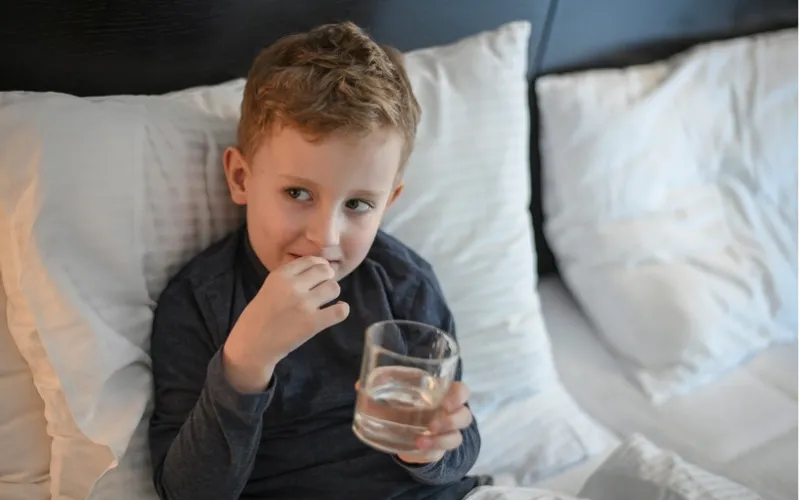
Recognizing a medication doesn’t mean knowing when, how much, or how it should be used.
“I’ve taken this medicine before.”
To a child, this might seem like a good reason to take it again.
But it isn’t.
A child might recognize the cough syrup they usually take when they have a fever. You might remember the medicine you took when your throat hurt. You might even know where it’s stored.
But recognizing a medication doesn’t mean knowing how to use it correctly.
That’s why there’s an important rule to learn early on.
A child should not decide to take medication on their own initiative.
"But I've taken this before."
Imagine you have a fever again and you recognize the medicine you took last time.
It seems like the same situation.
Can you take it again?
You shouldn’t decide this alone.
A previously used medication may not be suitable for what’s happening now.
Its use may depend on the medication itself, the situation, and factors such as age, weight, concentration, the amount to be administered, or the interval between doses.
Therefore, knowing which box it comes from or recognizing the taste of the medicine is not enough.
"It still hurts. Can I take more?"
Now imagine that an adult has already given you medicine.
After some time, you still have pain or a fever.
An idea might come to mind.
"If it hasn't passed yet, I'll take more."
But persisting symptoms don’t mean it’s appropriate to immediately repeat the medication.
The amounts and intervals between administrations need to be respected.
The child doesn’t need to learn to calculate when to take another dose.
They need to know how to do something much simpler:
Tell an adult.
Machadinho asks
Can two different boxes contain the same medication?
They may contain the same active ingredient.
The names and packaging may be different, and yet two products can have a substance in common.
Paracetamol is an example. It can be present in different medications and presentations.
If several products are used without checking their composition, duplication of the same substance may occur.
This information is not intended to teach a child to compare medications.
It serves to show precisely why this decision belongs to adults.
I don’t choose, combine, or repeat medications on my own.
"My brother has the same symptoms. Can I take his medication?"
No.
Two children can have similar symptoms and need different care.
A medication intended for one person should not be used by another simply because the symptoms seem similar.
And the rule also works in reverse.
We should not give our medications to siblings or friends.
Medications should not be shared.
And what about gummy vitamins and supplements?
Vitamins and dietary supplements are not medicines.
But that doesn’t mean a child can use them freely.
They should also be used according to their respective indications and kept out of the reach of children.
When they have a pleasant taste or a gummy-like appearance, this distinction becomes even more important.
For children, we can maintain a simple rule:
Medicines, vitamins, and supplements are used under the supervision of a responsible adult.
What can the child do on their own?
You can explain what you’re feeling.
“My head hurts.”
“I’m cold.”
“I feel nauseous.”
“I’m still in pain.”
“I don’t feel well.”
All of this is important information for the adult.
What the child doesn’t need to do is turn what they’re feeling into a decision about medication.
Machadinho Challenge
Let’s try a few scenarios.
I have a fever and I recognize the medicine I usually take.
Should I take it myself or call an adult?
Call an adult.
I already took some medicine, but I’m still in pain.
Should I repeat the dose or call an adult?
Call an adult.
My brother has some medicine and I have similar symptoms.
Should I take his medicine or call an adult?
Call an adult.
I found a pill and I don’t know what it is.
Should I take it to find out or call an adult?
Call an adult.
Did you notice?
The answer is always the same.
And what is the role of adults?
Medications should be kept out of the reach of children and in their original packaging.
After each use, they should be returned to their storage location.
When more than one person is caring for the child, communication is also important.
When applicable, caregivers should know which medication was administered, in what quantity, and at what time.
This way, parents, grandparents, and other caregivers can follow the same information and avoid duplicate administrations.
What if the child took medication alone?
If you know or suspect that a child has taken medication unsupervised, try to identify the product.
Whenever possible, check the name, dosage or concentration, the amount that may have been ingested, and the approximate time.
Keep the packaging available.
In case of suspected poisoning, contact the Poison Control Center (CIAV) at 800 250 250.
Do not induce vomiting yourself.
Do not give milk, food, activated charcoal, or other products as a treatment attempt without specific guidance from a healthcare professional or the Poison Control Center (CIAV).
In case of a medical emergency, contact 112.
Machadinho's Rule
A child doesn’t need to decide which medicine they need.
They need to know how to ask for help.
So, there’s a phrase to remember:
I don’t feel well. I call an adult.
Frequently Asked Questions
You should not decide on your own when to take or repeat a medication. Recognizing the product does not mean knowing if it is appropriate for that situation or at that time.
Not on your own initiative. You should inform an adult, who can verify the medication administered, the quantity, the time of the last administration, and the applicable indications.
You shouldn’t do this on your own initiative. Similar symptoms don’t necessarily mean the same medication is needed.
Yes. Although they are not medications, they should be used according to their respective indications and kept out of the reach of children.
Identify the product, keep the packaging available, and if you suspect poisoning, contact the Poison Control Center at 800 250 250. In case of a medical emergency, contact 112.
To save
Recognizing a medication doesn’t mean knowing how to use it.
When a child isn’t feeling well, they don’t need to choose what to take.
You need to ask for help.
I don’t feel well. I’ll call an adult.
References and sources
INFARMED. Medicines at Home.
Health Surveillance Secretariat. Prevention of accidents in children.
Government of Portugal. Poison Control Center, CIAV.
Government of Portugal. European Emergency Number, 112.
ASAE. Information regarding food supplements.
Tags:
