







- Your cart is empty
- Continue shopping


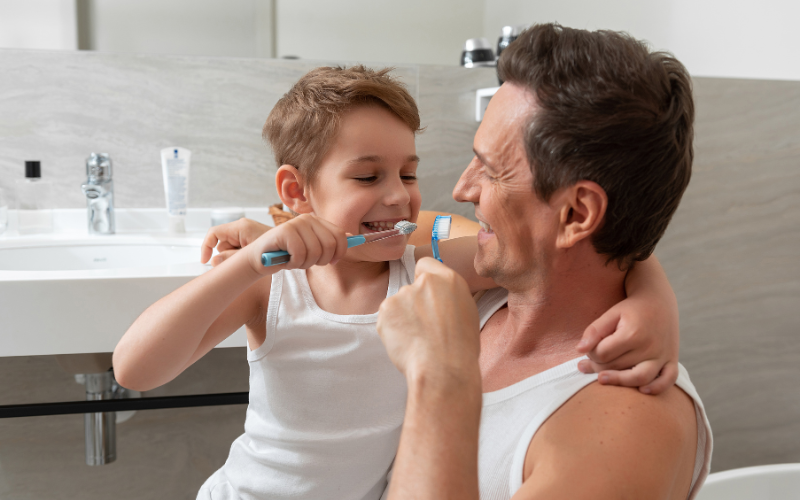
Children’s oral hygiene should begin during the first months of life, long before they are able to brush their teeth independently. Daily care is essential to prevent tooth decay, protect gum health and establish oral hygiene habits that can last a lifetime.
Although they are temporary, baby teeth play an essential role in a child’s development. They allow children to chew properly, contribute to speech development, help preserve the space required for permanent teeth to erupt and support a healthy smile.
When problems such as tooth decay or dental pain develop, the consequences can extend beyond the mouth. A child’s eating habits, sleep, well-being, school performance and quality of life may all be affected.
Tooth decay remains one of the most common chronic diseases in childhood. However, many cases can be prevented through appropriate oral hygiene, a balanced diet and regular dental appointments.
In this article, we explain when children’s oral hygiene should begin, how to brush their teeth at each stage of development, which products to use and the most important steps for maintaining good oral health from the earliest years of life.
When should a child’s oral hygiene routine begin?
Oral hygiene should begin as soon as the first tooth erupts. The Portuguese Dental Association recommends that parents or caregivers start brushing as soon as the child’s first tooth appears.
Before then, you can gently clean the baby’s gums with a clean, damp gauze pad, particularly after feeding.
How should children’s teeth be brushed?
The correct way to brush a child’s teeth varies according to their age and level of independence. During the first years of life, brushing should always be carried out by a parent or caregiver. As the child grows, they can begin to participate, but they will still require supervision to ensure that the correct technique is used and that their teeth are cleaned effectively.
The recommendations from the Portuguese Directorate-General of Health are as follows:
From birth to 3 years of age
Parents or caregivers should brush the child’s teeth twice a day. Brushing before bedtime is essential.
A soft toothbrush with a small head that is suitable for the child’s age should be used. During the first months, a gauze pad or silicone finger toothbrush may also be used, although a toothbrush is the preferred option once the teeth begin to erupt.
From 3 to 6 years of age
At this stage, the child can begin brushing their own teeth, but this should always be done with adult help and supervision. Their manual dexterity is still developing, which means that brushing carried out by the child alone is rarely sufficient.
The teeth should be brushed twice a day, including before bedtime. A soft toothbrush suitable for the child’s age and a fluoride toothpaste containing between 1,000 and 1,500 ppm of fluoride should be used. The amount of toothpaste should be approximately the size of the child’s little fingernail.
From 6 years of age
Most children are able to brush their teeth more independently at this age. However, parents should continue to supervise and intervene whenever the child does not yet have enough dexterity to clean every tooth surface properly.
The recommendation remains the same: brush the teeth twice a day, always including one brushing session before bedtime. A soft toothbrush should be used, or a medium-bristled toothbrush when recommended by the dentist, together with a fluoride toothpaste containing between 1,000 and 1,500 ppm of fluoride. The recommended amount is approximately the size of a small pea or around 1 cm of toothpaste.
Regardless of the child’s age, the quality of brushing is more important than speed. Making sure that every tooth surface is carefully brushed and maintaining a consistent daily routine are fundamental steps in preventing tooth decay and promoting good oral health from childhood.
Should children rinse their mouths after brushing?
After brushing, children should ideally spit out the excess toothpaste without rinsing their mouths with water. This allows some of the fluoride to remain in the saliva and around the dental plaque, extending its protective action.
Young children should always be supervised by an adult during this step to prevent them from swallowing too much toothpaste.
Why is fluoride important?
Fluoride helps strengthen tooth enamel and makes the teeth more resistant to the acids produced by bacteria in the mouth. These acids are mainly produced when the teeth are frequently exposed to sugars found in foods and drinks.
Fluoride toothpaste is one of the simplest and most effective forms of daily protection.
The use of fluoride in children has been widely studied, and recommendations have evolved over the years. According to the Portuguese Directorate-General of Health, the main source of fluoride should now be brushing with fluoride toothpaste from the moment the first tooth erupts.
The routine use of fluoride tablets or drops is no longer generally recommended. These supplements should only be used in children with a high risk of tooth decay, usually from the age of 3, and when recommended by a dentist or doctor.
Regular brushing with fluoride toothpaste remains the most important measure for preventing tooth decay, together with good oral hygiene habits and a balanced diet.
What about toothpastes with higher fluoride concentrations?
Toothpastes with a high fluoride concentration, such as those containing 5,000 ppm, should not be used without professional advice. They are only available by prescription and may be recommended for children aged 6 or over, adolescents or individuals with a higher risk of tooth decay, following an assessment by an oral healthcare professional.
Until what age should parents supervise brushing?
A child may want to brush their teeth independently from an early age, but this does not mean that they already have the dexterity required to do it properly. Supervision by a parent or caregiver is essential to ensure that the correct amount of toothpaste is used, the brushing technique is appropriate and the teeth are brushed for long enough.
The Portuguese Directorate-General of Health recommends that parents help with and supervise brushing until the child has fully mastered the technique, which usually happens at around 10 years of age.
In practice, the child can take part in brushing, but an adult should check that every tooth has been cleaned, particularly the back teeth, which are often more difficult to brush.
Dental floss: when should it be introduced?
Dental floss may be required when the teeth begin to touch and a toothbrush can no longer clean the spaces between them effectively. At this stage, parents should help the child because interdental cleaning requires coordination.
For older children, dental floss or other aids, such as appropriately sized interdental brushes, should be incorporated into the daily routine. Cleaning between the teeth is particularly important when the teeth are very close together, the child wears orthodontic braces, plaque tends to accumulate or the gums bleed.
Bleeding gums in children: is it normal?
Bleeding gums should not be ignored. In many cases, they may be associated with the accumulation of bacterial plaque along the gumline. Biofilm-induced gingivitis is one of the most common gum conditions in children and adolescents. It may cause the gums to become red, swollen or bleed during brushing.
The good news is that when gingivitis is associated with bacterial plaque, it usually improves with more effective oral hygiene and, when necessary, professional care. Brushing twice a day with fluoride toothpaste, age-appropriate interdental cleaning and parental supervision are central measures for preventing and controlling gingivitis.
Can all children use mouthwash?
Not always. Mouthwash does not replace toothbrushing and should not be used by young children without professional advice.
Fluoride mouthwashes are not recommended for children under the age of 6 because many are not yet able to rinse and spit them out properly, which increases the risk of swallowing the product. From the age of 6, they may be considered in certain cases, particularly when there is a higher risk of tooth decay, but they should be used under appropriate professional guidance.
When should the first oral health appointment be scheduled?
The first assessment by an oral healthcare professional should take place early, ideally by the child’s first birthday or after the first teeth have erupted. This appointment is not only intended to treat problems but, above all, to prevent them.
It provides an opportunity to assess the child’s risk of tooth decay, teach parents how to brush the child’s teeth correctly, answer questions about pacifier and bottle use and diet, and monitor dental development.
The role of parents and caregivers
Children’s oral hygiene depends greatly on the example set by adults. Bacteria associated with tooth decay can be transmitted from caregivers to children, which means that the oral health of parents is also important. Attending regular dental appointments, treating tooth decay, brushing the teeth and using dental floss are ways to protect their own health while reducing the risk of transmitting bacteria to the child.
Children also learn through repetition. When toothbrushing forms part of the family routine, it becomes more natural and less open to negotiation.
Practical tips to make the routine easier
Choose a toothbrush that is suitable for the child’s age.
Always use the correct amount of fluoride toothpaste.
Brush the child’s teeth twice a day.
Make brushing a calm and predictable part of the routine.
Use short songs or timers to help achieve an appropriate brushing time.
Keep toothpaste out of the reach of young children.
Replace the toothbrush when the bristles become worn.
Speak to a pharmacist, dental hygienist or dentist if you have questions about suitable products.
When should you seek professional advice?
You should seek professional advice if the child experiences:
Toothache;
White, brown or black marks on the teeth;
Persistent bad breath;
Red or swollen gums, or frequent gum bleeding;
Difficulty chewing;
Broken teeth or dental trauma;
Prolonged bottle or pacifier use that may affect dental development.
The earlier a problem is identified, the simpler the required intervention is likely to be.
In conclusion, caring for children’s oral hygiene is an investment in both their present and future health. Brushing should begin as soon as the first tooth erupts, fluoride toothpaste should be used in the correct amount for the child’s age, and parental supervision is essential.
Small daily routines, followed consistently, can reduce the risk of tooth decay, protect the gums and help children develop a more positive relationship with their oral health.
At Farmácia Dias Machado, we can answer your questions about toothbrushes, toothpastes, age-appropriate products and complementary care for a safer and more effective oral hygiene routine.
Brushing should begin as soon as the first tooth erupts. Before that, you can clean the baby’s gums with a clean, damp cloth or gauze pad.
Yes. Current key recommendations indicate the use of fluoride toothpaste in an amount appropriate for the child’s age.
Ages 3–6: The amount of fluoride toothpaste (1000–1500 ppm) should be about the size of the child’s little fingernail.
Over 6 years old: The amount of fluoride toothpaste (1000–1500 ppm) should be the size of a small pea or up to 1 cm of toothpaste.
Ideally, no. It is best to spit out the excess toothpaste without rinsing, so that the fluoride remains in contact with the teeth for longer.
Parents should supervise brushing until the child has sufficient technique and dexterity. Many children need help until their later school years, and supervision may continue until around age 10.
It should not be considered normal. It may indicate plaque buildup or gingivitis. If it happens frequently, it should be evaluated by a dentist.
As a general rule, mouthwashes are not recommended before the age of 6, unless advised by a professional. Even after that age, they should only be used when the child is able to swish and spit correctly.
Ideally, by the age of one or after the first teeth erupt. This appointment is important for preventing problems and providing guidance to parents.
Bibliographic References
Chapple, I., Gizani, S., Sanz, M., Declerck, D., Madianos, P., Clerehugh, V., Danser, M., Davidovich, E., Davies, J., Donos, N., Dursun, E., Figuero, E., Graziani, F., Gursoy, M., Jepsen, S., Joseph, C., Kebschull, M., Kraemer, N., Lambrinaki, T., … Herrera, D. (2026). Gingival and periodontal diseases and conditions in children and adolescents: Consensus report. Journal of Clinical Periodontology, 53(7), 1068–1099. https://doi.org/10.1111/jcpe.70033
Clark, M. B., Keels, M. A., Slayton, R. L., & Section on Oral Health. (2020). Fluoride use in caries prevention in the primary care setting. Pediatrics, 146(6), e2020034637. https://doi.org/10.1542/peds.2020-034637
Directorate-General of Health. (2021). National Oral Health Promotion Programme 2021–2025. Ministry of Health.
Krol, D. M., Whelan, K., & Section on Oral Health. (2023). Maintaining and improving the oral health of young children. Pediatrics, 151(1), e2022060417. https://doi.org/10.1542/peds.2022-060417
Portuguese Dental Association. (n.d.). Children’s oral health. https://www.omd.pt/publico/saude-oral-crianca/
Thornton-Evans, G., Junger, M. L., Lin, M., Wei, L., Espinoza, L., & Beltran-Aguilar, E. (2019). Use of toothpaste and toothbrushing patterns among children and adolescents—United States, 2013–2016. Morbidity and Mortality Weekly Report, 68(4), 87–90. https://doi.org/10.15585/mmwr.mm6804a3
U.S. Preventive Services Task Force. (2021). Screening and interventions to prevent dental caries in children younger than 5 years: US Preventive Services Task Force recommendation statement. JAMA, 326(21), 2172–2178. https://doi.org/10.1001/jama.2021.20007
Tags:
